New Rules for a More Transparent Property Market – Enforcement is Key
Since my letter to The Straits Times Forum in December 2014 regarding the accuracy issues of private property transaction data, the URA has improved the…
From the archive. Published in 2015. Prices, rules and interest rates may have changed since — check current figures before you decide.
By Property Soul (guest contributor)
Since my letter to The Straits Times Forum in December 2014 regarding the accuracy issues of private property transaction data, the URA has improved the property market data by releasing the nett prices of individual units sold by developers by the first half of 2015.
In URA’s 1 April 2015 press release, there were six major changes in the revision of the URA Property Price Index that promised higher representation of transactions and more meaningful comparisons among projects.
On May 18, URA finally put together the last missing piece by enforcing the publishing of actual transacted prices of uncompleted private properties sold directly by developers. There are also new rules that were amendments to the Housing Developers (Control and Licensing) Act passed in April 2013.
New rules announced by URA on May 18
Below is a summary of the URA’s press release on ‘Fostering a more transparent property market’.
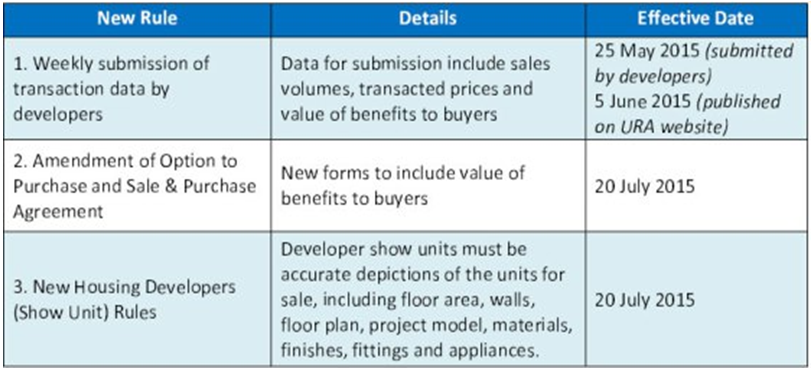
The first two rules are somewhat expected since they have been mentioned by the URA earlier.
The long-awaited transparent property transaction prices are now available with the compulsory submission of actual selling prices of units bought directly from developers, less all the stamp duty absorption, legal subsidy, cash rebate, rental guarantee, purchase incentive, etc. offered by the developer.
Developer tricks deployed in show units
A more interesting rule that comes into effect on July 20 is the requirement of accurate depiction of the show units.
As I pointed out in my book No B.S. Guide to Property Investment, there are countless tricks used by developers in showflats to make the units look spacious:
1. Replace a brick wall with a glass panel separating the living room and an adjacent bedroom;
2. Remove the wall separating two bedrooms to join together for a bigger room in order to hide a tiny bedroom;
3. Remove the wall and door of the kitchen, or show an open kitchen which is ‘an ID concept for display only’;
4. Extend the living room all the way to the balcony;
5. Build a ceiling higher than the actual unit;
6. Remove the doors for all bedrooms and bathrooms;
7. Hide any pillar, beam or air-con ledge that exists in the original flat;
8. Minimize the width of walls and depth of wardrobes for a more spacious bedroom;
9. Show rooms, furniture and appliances not built to scale; and
10. Place full length wall mirrors, install see-through wardrobes or use transparent furniture.
Enforcement is key
Back in April 2013, Parliament had already approved amendments to the Housing Developers (Control and Licensing) Act to improve safeguards for buyers of uncompleted private residential properties.
Besides providing the public with better information on the private residential property market, the Housing Developers (Show Unit) Rules also required developers’ showflats to follow the same dimensions of structural walls and ceiling height as approved in the building plan.
The amended act also empowered the Controller of Housing to investigate cases of non-compliance. For non-compliance, the maximum fine imposed on developers was raised from $20,000 to $100,000, while also imposing an imprisonment term of up to 3 years.
But the questions are: Did we notice any difference in developer showflats at all in the new project launches? Have we heard about any incidence of non-compliance and fine being imposed since passing of the act?
While we appreciate the government’s efforts in introducing new rules to protect the interests of home buyers, it is also critical to see how the authority implements them effectively.
In a nutshell, while a truly transparent property market can enable prospective home buyers to make better-informed purchasing decisions, the rights of the consumers can only be protected through strict enforcement of the laws by the relevant authority, especially when people are buying off plans in uncompleted residential projects.
By guest contributor Property Soul, a successful property investor, blogger, and author of the No B.S. Guide to Property Investment. Posted courtesy of www.Propwise.sg, a Singapore property blog dedicated to helping you understand the real estate market and make better decisions. Click here to get your free Property Beginner’s and Buyer’s Guide.